Translate

Showing posts with label Ganas. Show all posts

Thursday, April 21, 2022

Pretty Women


My first memories of my maternal aunts were as middle-aged (at least) women. Perspective: My mother was the 10th of 11 children. She was 30 when I was born, so her sisters ranged in age at that time from 34 years to 48 years old. For a small child, they seemed “old”.

I had a fresh look at these women when a cousin recently sent me a box of old photos including some of my aunts’ wedding photos. It was wonderful to see my aunts as lovely young women.

I scanned these photos and then took advantage of the colorizing service offered by MyHeritage.  You may need to be a member to take advantage of this service.

They are posted below along with a photo of my maternal grandmother that was probably from the mid 1890’s judging by her dress.


And my maternal Grandmother, Stella Schipp  
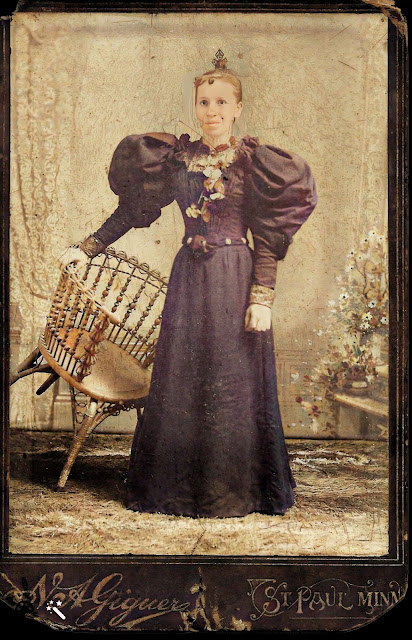
I am so glad to be reminded that they were once young, lovely and lively. It would be great to be able to go back in time and know them as they were then.


Thursday, July 22, 2021

A Fork in the Road – What to do Next


Well, I accomplished one task I mentioned in my last post – I found the connections between my Minnesota Ganas clan and the ones that settled in Milwaukee and Buffalo. We are all descended from Johann Ganas, b 1779, d 1830

Martin Ganas came to the US in1890 and settled in Buffalo.

Johann arrived in 1891 and settled in Milwaukee

Ignatius (My Grandfather) immigrated in 1892.

Makes me wonder whether these semi-distant cousins were in communication about their emigration plans while still in Poland.

All records are from the town of Czerlejno which you can find with Google earth; and even do a Street View tour along the two main crossroads.

I am truly grateful for the work of the volunteers who transcribe  these ancient records for databases that allow us to find our ancestors.


What’s next?

Finishing the Google earth trip/tour of my paternal immigrants seemed like a good idea for the next project until I found that Tour Builder is no longer supported. So that project turns into a YouTube project. This will take a while. Storyboard and finding the right images. I also need to improve my narration voice.  I’ve done a few other family stories on YouTube. See them here: Family Stories

And also -

I’ll continue to look for resources for my kids’ Bohemian heritage.

I’ll continue to check for new DNA matches.

Time to start working on a storyboard.


Sunday, February 11, 2018

Aunt Martha - a Role Model


 Aunt Martha was unique in my family. As a child, I didn’t understand what a role model she was. Martha was born in St Paul Minnesota in1907; the 7th child of my maternal grandparents Ignatz and Stella Ganas. 

She was the only one of my mother’s 10 siblings who moved away from St. Paul as a single person. I’ll never know why she left, but the most common of the family lore says that she fell in love with a Jewish man. Religious conversion was not in the cards for either of them. So, she got on a train with a couple of friends and headed west sometime in the 1930’s.

After visiting towns in North Dakota and Montana she spent a season working in. Yellowstone National Park. She took a lot of photos, but not one has a date on it.  By 1938 she was in Pasadena, California taking snapshots of the Rose Parade. She finally settled in Oakland, California. She travelled the west coast and made regular trips back to St. Paul.

My first real memories of Aunt Martha were her visits to us in Chicago.  She was a superstar to me because of her travels but mostly because she traveled by air. What luxury that seemed to me! We’d go to Chicago’s Midway airport (this was way before O’Hare), go out on the observation deck and watch the planes arrive and depart.

Martha would arrive on a TWA Constellation.  (Here's another article.)  What a beautiful plane! I fell in love with it and still love it to this day. The sleek and graceful curves truly set her apart from other planes of the time.


I loved Aunt Martha because she was a loving, kind, gentle woman, and also because she was never condescending to a little kid like me.

I grew up in a time when girls were still expcted to grow up, become secretaries, get married and have babies. I grew up appreciating Martha her for her spirit, her poise, her wanderlust and her independence. All were an inspiration to a young girl. Thank you Aunt Martha.


Wednesday, July 5, 2017

Genealogy Blog Party: DNA Discoveries


DNA testing has led me down a wonderful path of discovery.  Not about me and my family but about European history. 

My DNA was tested by 23andMe back in 2013. I had breast cancer and, for my daughter’s sake, was concerned about BRCA gene mutations. I turned to 23andMe because a $4,000.00 full genetic assay just wasn’t in the budget. I was relieved to find that I don’t have that mutation.


My ethnic mix showed no big surprises, but a couple of small ones.  My favorite surprise is the 3% Neanderthal component.  I love it!  That’s been the subject of a couple of previous blog posts:


And just today came across another article: 

New DNA From a Neanderthal Bone Holds Evidence of a Lost Tribe of Humans


I’ve traced my ancestry back to the late 18th century in Poland. Ethnicity estimates from 23andMe, FTDNA, My Heritage, and Gedmatch all agree that is where my ancestry is centered. But they also show Southern European and Northern European roots, and that got me wondering if those are real or are false positives.

Poring over history books, historical atlases, and Wikipedia gave me quite an education.  The Northern European component may have come from the late 1600’s when Sweden invaded Poland. There are still ruins of Swedish fortifications in Poland.  Possibly this is the source of my Northern European connection.

My mother’s maiden name is Ganas, a name more common among Greeks than among Poles. It seems that in the 12th and 13th centuries merchants from Greece and Turkey plied their trade in Central Europe. My guess is that at least one of them, with the name of Ganas, stayed in Poland.  I have yet to convince any of my male cousins from that line to do a DNA test; but I’d love to see what their Y chromosome could tell us.

The knowledge and insights into history that I’ve gained are priceless.
Here are links to previous posts European history.


As for family discoveries, DNA has helped me find only two previously unknown 2nd cousins – none more remote that that.  I keep hoping to find more. I know they’re out there somewhere.


Saturday, May 6, 2017

Projectus Interruptus


My project for a video of my Ganas family history in Poland didn’t get off the ground because I realized that I needed more information. I ordered a couple of FHL (Famiy History Library)  microfilms and put it on hold. Now that I have as much information as I can reasonably get for now, it’s a matter of getting materials organized and creating the video.

But wait…

A message arrived from one of my DNA matches on 23andme. Turns out that she’s a 2nd cousin 1x removed on my Schipp line!  YAY!!  My attention immediately shifted to that line.  Dug out copies of records that haven’t yet been scanned and verified that they’re all duly recorded in my family tree.
 
But wait…

There are a couple of things that don’t match up. So back to online records on FamilySearch, Ancestry, and the Polish site BaSIA.  My great grandparents, Michael and Elizabeth Schipp had children that don’t appear on immigration passenger lists, but for whom I find no death record. Then there’s the daughter who is on a passenger list with her mother but for whom I find no birth record.  A new mystery to be solved. A new BSO (Bright Shiny Object) to chase.

But wait….

I’m convincing myself to let this mystery rest for a while and get back to the video mentioned above.  BaSIA is a volunteer project indexing vital records in Poland.  I have no idea what percentage of records have yet to be indexed.  The volunteers may simply not have gotten to these “missing” records yet.

Focus!

I will get back to this mystery.


Monday, May 1, 2017

Microfilm Monday


In my 10 March, 2017 post I described finding a connection in my Ganas line to a family that settled in Milwaukee, Wisconsin. It gets even better.  Further research on BaSIA led me to records of other Ganas individuals in the same line – descended from my 3X great grandfather, Johann Ganas.  Looking at records on Ancestry.com and FamilySearch.org showed me additional US immigrants in Buffalo, New York, and Detroit, Michigan.

BaSIA gave me links to digitized records at the State Archive in Poznan, Poland where I was able to determine where some of Johann’s children were married; and where some of  his grandchildren were born and married.  But state archives began in 1874, and very few Catholic church records are online.  So, that sent me back to FamilySearch to look for microfilms from the specific towns for years before 1874.

The films are finally here!  I’m anxious to see what new information I can dig up.


Tuesday, April 11, 2017

I is for Ignatz Ganas - 2017 A to Z Challenge


Ignatz Ganas is my maternal Grandfather.  Family lore from my mother makes me especially curious about him.

Here’s what I know for certain:
·         Vitals
o   Born:              29 June, 1870  Chorzalki, Poland
o   Immigration:  17 August,.1893 Baltimore, Maryland, USA
o   Married:          18 October, 1898  St. Paul, Minnesota, USA
o   Died:               12 January, 1940 St. Paul, Minnesota, USA
·         His mother’s family owned an inn (tavern)
·         His father died in 1873
·         His mother remarried in 1876

Based on my mother’s stories, his youth was different from my other ancestors.

At some point he was sent to live in Berlin with his mother’s twin brother who was a tailor.
Why?
Was he sent to be an apprentice to his uncle?  Seems a reasonable guess because he did learn tailoring and taught it to my mother.
When?
What was the age at which boys became apprenticed? Perhaps I can learn this and make a guess at his age.

When he was 16 years old he left Germany to avoid conscription into the army.
This makes sense because his father, Joseph, was in the military when he died. I’ve not yet been able to find any military records.  An 1873 church record shows Joseph as a “deceased soldier”

If he left Germany at 16 and came to the US at 23, where was he and what did he do for those years?
My mother said that he spoke 6 languages so he probably spent time in several European countries?  Which ones?

How did he manage?
Did he make use of his tailoring skills?
Was he an itinerant laborer? 

My imagination comes up with all kinds to possibilities, some grand, some very ordinary.

Come visit me in my dreams, Grandpa, and tell me all about it.


Tuesday, April 4, 2017

C is for Collateral – 2017 A to Z Challenge


Until recently, my research on collateral lines has been limited to those living in the US – my great aunts and uncles   The discovery of distant Polish relatives in the US got me busy looking at collateral lines from a 3rd great grandfather born in Poland in 1779.

I should have done this a long time ago!  On the other hand, the information I found may not have been easily available a long time ago.

Using information from The Poznan Project and BaSIA I was able to locate and download records from The State Archive in Poznan. Adding this data to my tree on Ancestry.com brought up a forest of shaky leaf hints.

My 3rd great grandfather, Johann Ganas, lived in the small village of Czerlejno which was the estate of a Polish nobleman. Johann’s sons had to look elsewhere for work but they stayed within a 10-mile radius of their birthplace. In the next generation, some families moved farther away but still within 20 miles of Czerlejno.

The Ancestry hints showed me that 3 Ganas families came to the US between 1887 and 1891. Two of them settled in Buffalo, NY; and one in Milwaukee, WI. My grandfather, Ignatz Ganas arrived in 1893 as a single man and settled in St. Paul, MN.  Maximillian Ganas, a Roman Catholic priest, arrived in Detroit, MI in 1911.

WOW!!  What fun!  I have more Polish cousins in the US than I’d ever imagined.  With ongoing research, I hope to be able to find living distant cousins.


Monday, April 3, 2017

B is for Bronie – 2017 A to Z Challenge


Aunt Bro was my mother’s 2nd oldest sister. Her mother called her Bronie.  Before I started doing genealogy, everything I ever saw about her said her name was Bernice.  Bernice = Bro?  Didn’t make sense to me.

It finally made sense when I was able to review the sacramental records at St. Adalberts church in St. Paul, Minnesota.  My mother’s parents gave their children Polish baptismal names.  They used American names thereafter but grandma always referred to Bronislawa as Bronie and she was Bro to everyone else.

One mystery remains:  why was Bro’s husband, Daniel Muccio, referred to as Uncle Jim?  I’m sure I’ll never know.


Monday, March 27, 2017

The Name Game


I spent today (virtually) at the State Archive in Poznan with the Ganas family. My brain got tied up in knots for a while.

In an effort to honor their elders, 18th and 19th centuries families often present us with a puzzle of some magnitude.  Too may Johanns born too close together can be very frustrating.

Be kind to your descendants who may be interested in family history.

If your name is John, and you have an uncle, a grandfather, and cousins named John, think about breaking the chain. There are many honorable names:
Hezekiah, Ezekiel. Mergetroyd, Englebert. 

On behalf of your future family historians, I thank you.


Wednesday, March 15, 2017

The Dead Ones Are Easy


 It takes much more effort to find living cousins.

Now that I’ve established a connection with the Ganas family in Milwaukee, Wisconsin, I’ve begun trying to learn about them in hopes of finding living distant cousins.

I wish I’d had this information 30 or 40 years ago when I lived within easy driving distance from Milwaukee. These are relatives on my maternal side but I don’t think that my mother was aware of them.  It is a pretty distant relationship.

The low-hanging fruit is the first phase.  Ancestry.com, FamilySearch, and  Find A Grave yield a pretty good picture of the family in the late 19th and early 20th century.  There are death records, some marriage records and some birth records. These are readily verifiable sources.


The next phase requires more effort. There are a few gems to be found on a few public trees on Ancestry.  There are images of newspaper obituaries that provide starting points for more research.  I’m grateful to the others who have put these clues out there for me to find.


Thursday, March 9, 2017

Connecting a Shrub to my Tree?


I’m deep down a rabbit hole these days because Ancestry.com gave me hints about one of my lines from another public tree. Can I connect the Ganas family in Milwaukee to my Ganas family in St. Paul??

There are tantalizing similarities.  My 3rd Great Uncle, Mathias Ganas was born in 1821.  I found his baptismal record on a FHL  (Familysearch.org) film.  I have not yet uncovered a marriage record for him.

But the other tree in question has a Matthias Ganas born in 1824 – maybe.  It’s a “maybe” because when I go to The Poznan Project searching for his marriages it shows that he was married twice.  His first marriage in 1852 gives his age as 28 which puts his birth year at 1824.  His second marriage (as a widower) in 1868 shows is age as 46, giving a birth year of 1822.  Are either of them correct?  I’ve ordered the appropriate FHL film so maybe I’ll find more information. If I find his birth record on this film, I’ll know that he’s not MY Mathias.

In the meantime, I’ve returned to the search for Ganas records in Poland.  The BaSIA database is another resource created by volunteers transcribing archived records. This database continues to grow as more records are being transcribed. Entering a surname results in a map showing where, in Poland, there are records for that name that have been transcribed.


To the right of the map are the names of the locations with a graphic that roughly indicates the number of records. Clicking on the location results in a list of the records there. 


At the right of each record citation is a link to the archive that hold the records including information to find that record if it has been filmed and digitized. In the case of the Poznan archives, the record images may be downloaded.     

So I’m busy filling up a new flash drive.   Even if I cannot connect the Milwaukee shrub to my tree, I’m learning more about this part of my family.                                      


Sunday, March 5, 2017

Fearless Females 1


I’m getting a late start on Lisa Alzo’s tribute to Women’sHistory Month.  She has a list of blogging prompts to help us get started.  Today’s (5 March) prompt is:

How did they meet?

My parents met in 1st grade at St. Adalbert’s school.   St. Adalbert’s was (and is) one of two Polish Catholic parishes in St. Paul, Minnesota.   Teachers were strict Felician nuns. Photo here  My parents remained in contact with some of them even into adulthood.

My mother was trained by the nuns in classical drawing.  This gave her some special privileges when artwork was needed for the school

My father won a prize for his mathematical talents.

They made their First Communions at the same time.


I wish I knew more about their school days and how their friendship blossomed into love


Ambrose Dachtera - Emily Ganas
September 5, 1936

Fearless female?  Anyone had to be pretty fearless to marry and start a new life in the middle of the Great Depression.


Sunday, October 30, 2016

Who’s Who?


I wish I could positively identify everyone in this photo. The best I can do is a semi-educated guess – especially on the children..

Based on comparisons with other photos, I believe that my grandmother, Stella Schipp Ganas, is on the left, and her sister, Mary Schipp Fierstein, on the right.

My best guess is that the photo was taken in 1910 or 11. If was 1911, Stella also had an infant not pictured. The sisters lived next door to one another at 263 and 264 Upper Levee in St. Paul, Minnesota. Their parents, Michael and Elizabeth Schipp brought them from Poland to the US in 1887 and settled on the levee of the Mississippi river.

The levee was where many immigrants from many countries put down their American roots.  The location was less than ideal because of the frequent Spring floods as snowmelt raised the level of the river.  On the other hand, St. Paul was a busy steamship port for both freight and passenger travel. Grain milling, lumber and railroads provided job opportunities. St. Paul was a good place to be.

This link will take you to a page with some pictures of early St. Paul.


Tuesday, September 6, 2016

Back to Basics I – Census Records


 Census Data – Facts or Clues?

Following up on my previous post Family History From Census Records, I am reviewing my ancestors in census records and city directories. Discrepancies in census records can be a stark reminder that these records are only clues; and that a given census records alone cannot be deemed as a fact.

What’s wrong with this picture?


The image above shows the 1910 US Federal Census information recorded for the residence of my great grandparents, Michael and Elizabeth Schipp. Some of it is correct. 
  • ·         The surname is misspelled (not uncommon)
  •  ·         It shows that 5 of their daughters were married (correct) and living at that address (incorrect)
  •  ·         Daughter “Otela” is actually “Stella”.
  •  ·         Daughter Helen and her family do live with Helen’s parents. But Helen is listed twice. The other 4 married daughters are living at other addresses with their husbands and children. 
  •  ·         In spite of what the census shows, only Helen and Pauline were born in Minnesota; the older children were born in Poland.


What happened here? 
  • ·         What did the census taker ask?
    • o   If he asked the names of Michael and Elizabeth’s children, that’s exactly what he got. Did he specify that he only wanted those at this particular residence?
  • ·         Who gave the information?
    • o   That is not possible to know.
  • ·         Was there a language issue?
    • o   Very likely.


Verify! Verify! Verify!

Here’s the 1910 US Federal Census page that shows my grandmother Stella Schipp Ganas with her husband and family (highlighted).  Living next door is Stella’s sister Mary and her husband and family. 


Stella and Mary lived farther down the same street as their parents. But. Different Enumeration District; different census taker.

By the way, my grandfather was called “Nick” but his name was Ignatz in Polish, Ignatius in English.


Verify! Verify! Verify!


Sunday, April 24, 2016

A to Z Challenge – U is for Upper Levee


The Upper Levee in St. Paul, Minnesota is where countless immigrants made their first home in the United States. Literally on the banks of the Mississippi river with mud and annual floods, this was certainly not the “streets paved with gold” vision of America. Italian immigrants made up the largest ethnic group on the levee, but there were also large numbers from Poland, Bohemia, and Scandinavia.


The ship landings here were the northernmost ports on the Mississippi. Between the railroads and the river, St. Paul was the transportation hub of the upper Midwest.

My great grandparents, Michael and Elizabeth Schipp (Sip) made their first US home on the levee. Most of their grandchildren were born here including my mother and her siblings (children of Ignatz Ganas and Stella Schipp Ganas)  shown in the photo below.


In this 1917 snapshot, they’re arranged by height rather than age. Fourth from the left is actually the oldest.  WW I was still going on and you see the 2 youngest girls, Julia and Emily (my mother) dressed as nurses and the two youngest boys, Chester and Frank dressed as doughboys.  Visible as a horizontal line in the upper background is the High Bridge that spanned the river connecting the bluffs on either side.  Gives perspective on the levee relative to the rest of the city.


Saturday, April 23, 2016

A to Z Challenge – T is for Teamster


My maternal grandfather, Ignatz Ganas was a teamster back in the day when the term actually reflected what they did.  They drove teams of horses. He also did some tailoring for private clients.


I wish I knew more about him back then. Was he independent? Did he haul for some specific company or companies?  I do know that he owned his team and a wagon. He died before I was born, but I remember his work / horse shed. When I was a curious child, I badly wanted to explore that shed. It still smelled of the dressed leather tack; it had a grinding wheel and a lot of very interesting looking stuff. Where’s that time machine I keep asking for??

Monday, April 11, 2016

A to Z Challenge – I is for Ignatz Ganas


Ignatz Ganas was my maternal grandfather.  He was born in 1870 at Chorzalki – a tiny village near Iwno, Poland. He died in 1940 – before I was born – in St. Paul, Minnesota.

His life before he came to the US is a bit of a mystery because it is mostly hearsay. I have copies of the church documents for his baptism and his marriage. I have a copy of the passenger list showing his arrival in the US. I have stories my mother told me.

Apparently his mother’s family owned a tavern and he told stories about working behind the bar as a child.  His father, Joseph, died when Ignatz was 3 years old. His mother, Marianna Jaskowiak Ganas, remarried when Ignatz was 6 years old.

The rest of my “knowledge” of him is family lore – none of which I have been able to verify.

He was sent to live with his mother’s twin brother in Berlin. His uncle was a tailor who taught Ignatz the trade.

Ignatz left Prussia/Germany just before his 16th birthday in order to avoid conscription into the army.

I do know that he was back in Germany in 1893 because he sailed from Hamburg and arrived in the US in Baltimore that year. He was 23 then.

I would love to know where he traveled and how he lived for those 7 years. My guess is that he made a living tailoring. But where???

This is one mystery that most likely will never be solved. Back to my wish for a time machine.


Friday, April 8, 2016

A to Z challenge – G is for Ganas


My mother’s maiden name was Ganas. Her father immigrated to the US from Poland. But Ganas is not typical of Polish surnames. I’ve traced the family back as far as my 3X great grandfather who was born in 1779 in Czerlejno, Poland so I know that the family has been in Poland for more than 300 years.

But I wonder where they originated.

When I’ve done searches on that surname, the results seem to be predominantly of Greek origin. Did my Ganas ancestors originate in Greece?  When and why would they resettle in Poland?

My reading of Polish history tells me that in past centuries, Poland was a melting pot.  There were immigrants from many other nations.

There are also the many wars that occurred in that part of the world over the centuries as various kings sought to enlarge their empires. Foreign soldiers could have stayed in Polish territories.

I also read that in the late middle ages, there were many Greek and Turkish merchants and traders doing business in Poland. 

Did one Greek trader decide to remain in Poland?  In love with the land? In love with a girl?

I have 3 male Ganas first cousins and with any luck I’ll be able to convince them to do DNA testing. I’d like to see what that Y chromosome has to say.


Wednesday, April 6, 2016

A to Z Challenge – E is for Emily


My mother, Emily Ganas Dachtera was born in 1912 – the 10th of 11 children.

She was a gifted artist and seamstress who never had the opportunity to capitalize on her talents.  One of my favorite memories is of the year she produced a gorgeous landscape in icing on my birthday cake. There were many challenges in her life, not the least of which was a rebellious daughter (me). 

She died at the age of 98. I still miss being able to talk to her on the phone.

Love you, Mom