Translate

Showing posts with label family history. Show all posts

Saturday, May 27, 2017

Owning a Piece of Someone’s Life


I plagiarized borrowed this title from a post on Olive TreeGenealogy by Lorine McGinnis Schulze because her post describes my feelings as well. Owning objects that were a part of a person’s life does seem to me like owning a piece of that life.  I have very few such objects – all extremely precious to me.


I have my Dad’s rosary.  My parents were devout Catholics who prayed the rosary daily.  It’s not just something that belonged to him; it is something that was important to him that he used every day.

A small diamond that my Dad gave to my Mom represents their love and devotion to one another. It is more precious to me than its monetary value.


I have my Aunt Martha’s First Communion prayer book - in Polish. It was not merely a token of that occasion, but something she used often enough that the spine is repaired with adhesive tape. She was a delightful woman full of spunk and spirit.


There are a few more items in my treasure chest - all equally cherished.

Photographs are great, but I love having something tangible to reinforce the memories and reality of their lives


.

Friday, May 19, 2017

Missing Pieces


Searching for missing pieces of information is the definition of a family history project. I’m looking at another family jigsaw puzzle with many missing pieces.

In the past few months, via DNA matches, I’ve learned of two distant cousins in my Schipp line and I’m now down that particular “rabbit hole”.  The video project is on the back burner for now.

Both of these new cousins are descended from great aunts on my mother’s side – my great grandfather, Michael Schipp (Sip) is our MRCA (most recent common ancestor).  Even though I’d said that I’d put it aside for a while, I’m back looking for Sip families in Poland

Using BaSIA, I’ve found a treasure trove of Catholic church sacramental records at the State Archive inPoznan. Now the job is to get them matched up as best I can.  MS Excel is a great tool for this.  I’m building this spreadsheet


Once I get the information entered I’ll be able to sort it every which way to try to extract facts, matching parents with children and grandchildren, seeing local migration patterns, and more, I hope.  There are several families clustered with an area of about 3 square miles, but it seems that a few of them moved from one place to another.

The challenge here is reading the records. BaSIA gives most of the vital facts, but there should be more information in the record itself. Unlike later church records which were written in Latin, these older records are written in Polish.


I’ll be busy for a while.


Monday, May 1, 2017

Microfilm Monday


In my 10 March, 2017 post I described finding a connection in my Ganas line to a family that settled in Milwaukee, Wisconsin. It gets even better.  Further research on BaSIA led me to records of other Ganas individuals in the same line – descended from my 3X great grandfather, Johann Ganas.  Looking at records on Ancestry.com and FamilySearch.org showed me additional US immigrants in Buffalo, New York, and Detroit, Michigan.

BaSIA gave me links to digitized records at the State Archive in Poznan, Poland where I was able to determine where some of Johann’s children were married; and where some of  his grandchildren were born and married.  But state archives began in 1874, and very few Catholic church records are online.  So, that sent me back to FamilySearch to look for microfilms from the specific towns for years before 1874.

The films are finally here!  I’m anxious to see what new information I can dig up.


Thursday, April 6, 2017

E is for Emigration A to Z Challenge


All four of my grandparents emigrated from Poland in the 1880’s.


How does a family decide to leave their homeland? Extended family has probably lived in the same area for generations. Parents, brothers, sisters, uncles, aunts are close enough to visit easily. Their support system is well established and reliable.

Why abandon this seemingly comfortable way of life to endure the indignities of weeks at sea in steerage, and the unknowns of a new home in a strange land?

The answer seems simple in some cases such as the Irish potato famine. It was a matter of survival.

Why did my Polish ancestors come to the US?  It’s not surprising that the answer has to do with politics and power. Heads of government who sought to expand their realms and control the populace.

In the 19th century, my families were in Prussian Poland where the government was imposing strict Germanification on its provinces that were once Poland.  The Polish language was forbidden.  All civic offices and school classes were conducted in the German language.  It was forbidden to teach the Polish language even as a foreign language. German emigres to former Polish lands were given priority for jobs and land purchases. Poles were relegated to second-class citizens.

Although Poland did not exist on a map in the 19th century, Poles still considered themselves to be Polish and chafed under Prussian rule.

I would love to know the family conversations that led to the decision to emigrate.  It must have been difficult.

I am grateful that they made those decisions.  I was born in 1942 in the USA. I cannot imagine being born in 1942 in Poland. 

A  most heartfelt thank you to my great grandparents who took the risk to come to a new country.  Words cannot express my gratitude.


Monday, March 27, 2017

The Name Game


I spent today (virtually) at the State Archive in Poznan with the Ganas family. My brain got tied up in knots for a while.

In an effort to honor their elders, 18th and 19th centuries families often present us with a puzzle of some magnitude.  Too may Johanns born too close together can be very frustrating.

Be kind to your descendants who may be interested in family history.

If your name is John, and you have an uncle, a grandfather, and cousins named John, think about breaking the chain. There are many honorable names:
Hezekiah, Ezekiel. Mergetroyd, Englebert. 

On behalf of your future family historians, I thank you.


Sunday, February 12, 2017

Gone Fishin’ – Another Adobe Spark Video


I still love Adobe Spark. It’s pretty much idiot-proof. My first two videos were created using Adobe Premier Elements and Audacity.  They came out ok, but were not as simple as Adobe Spark.

Gone Fishin'


The two most difficult tasks are photo selection and narration.  The experts say that 6 minutes is maximum length for videos like this. In my experience, the story dictates length. So far my max is less than 5 minutes. I tend to select the photos first, but sometimes writing the narrative dictates which photos to use for a story. In the end, it’s just fun to do.


Tuesday, January 31, 2017

History and DNA


In this time of confusion in the US, the focus is on specific immigrants, but all immigrants and children of immigrants are concerned. My stepdaughter, Julie, posted on Facebook reminding us that we are all immigrants and descendants of immigrants.  In her post she asked people to respond with their own county of ancestry.  This made me reflect on my current reading of The Emergence of Society subtitled European and English History 300 – 1200 by Colin Davies.


Many people are surprised and bewildered when their DNA ethnicity analysis shows results that are at odds with their family lore and known family history.  “But I KNOW that I am British!  This analysis must be wrong.”  “I know that I am Polish!  Why is my analysis showing Scandinavian DNA?”

We identify with the nations from which our ancestors emigrated.  But nations, as we know them today, did not always exist.  Before there were nations, there were countless kingdoms vying for land and resources and power.  Some were individual tribes; while others consisted of several amalgamated tribes.  Over the centuries, these kingdoms advanced and retreated; formed coalitions and split apart.

History has many of the answers.  Here is a map of Europe as it was at about 125 AD.  Do you recognize the designations?  Probably only a few of them. What we see here are many tribes and kingdoms.  Over the centuries these kingdoms conquered or were conquered, were absorbed into other kingdoms or retreated and lost leadership and identity.


Are you baffled by the ethnic mix shown in your DNA test results?
 
Consider History. For example:

In the 10th and 11th centuries, Norse and Dane incursions plagued the British Isles.  Eventually these raiders brought their families and settled in what is now England and Scotland.  In November, 1016, Cnute. a Dane, became king of England.[1]

Extensive communities of Danes and Norwegians imply that many of today’s Britons may have more Norse and Danish DNA than Anglo-Saxon DNA.

In the year 1626 Sweden invaded Poland. Remnants of Swedish fortifications still exist.  Can there be any doubt about Swedish/Polish personal liaisons that show up today’s DNA tests?

In my own case, my mother’s maiden name was Ganas. Although I’ve found my Ganas ancestors back to the late 1700’s in Poland, this is not a “Polish” name.  Surname searches return mostly Greek origins.  My guess? Apparently in the 12th and 13th centuries, there were many Greek and Turkish merchants in the area that is now Poland.  Until I can find real evidence, my guess is that a Greek merchant named Ganas fell in love with a Polish girl and stayed in Poland.  All four of my grandparents were born in Poland.  But maybe there was a Greek immigrant somewhere in the mix 800 years ago.  I’ll probably never know for sure, but I think I’ve made a reasonable guess.

At best, the ethnic mix results from DNA tests are educated guesses based on what data is currently available. They’ll become more accurate as new data is acquired.


Before you reject your DNA ethnic results, check the history books.  You may find something new and interesting.


[1] Emergence of Western Society by Colin Davies  p128

Sunday, November 6, 2016

Family History in Perspective – Inflation


Old-timers may talk about way back when bread was 5 cents a loaf. I actually remember when
gasoline was $0.30 per gallon. Sounds pretty cheap.  BUT. I got my first part time job in 1958 making minimum wage: $1.00/hour.  My mother spoke about working in the late 1930’s for $0.39/hour.  Ahhh! The good old days!

When we look at our parents and grandparents in the 1930 US Federal census records, we see the value of their homes, or what they paid monthly in rent. The numbers look pretty small. Likewise, when we find information on wages and salaries, those numbers look pretty small. So, I’ve spent a little time comparing then and now.

Using the CPI (Consumer Price Index) Inflation Calculator from the US Bureau of Labor Statistics, I see that things may not have changed that much. It is also important to realize that the world of finance was much different in the past.  It was more difficult to get a mortgage or other kind of credit.  Savings were often kept at home rather than in banks. Only the well-to-do had checking accounts.  By contrast, creditors, today are often more than willing to extend credit to almost anyone who is breathing.

A home valued at $10,000.00 in 1930 is valued in 1916 dollars at just over $144.500.00. 

In 1938 in St. Paul, Minnesota, the average annual income was $600.00 for an individual and $1700.00 per household (multiple wage earners)[i]

1938                           2016
$600                           $10,200
$1708                         $29,200

That still doesn’t look like much in today’s dollars, but this was the Great Depression when very many were unemployed.

My 1958 $1.00 minimum wage would equal $8.35 today. 

Certainly there are many more factors to consider when trying to compare yesterday’s economics to today’s; but even this simplistic comparison is interesting.


Wednesday, April 13, 2016

A to Z Challenge – K is for Kulturkampf


In its narrowest definition, Kulturkampf was Otto Von Bismark’s struggle with the Roman Catholic Church in the early 1870s. In actuality, it had an enormous effect on the Polish provinces of Prussia beyond the conflict between church and state.

Most Poles were Roman Catholics.  Kulturkampf affected every aspect of their lives.

In 1872, a decree demanded that the use of the German language was compulsory in all state schools. The Polish language was banned -  even as a foreign language. [1]   In all courts and public offices, down to the local post office, business was conducted only in the German language

This was a key move in the process of Germanification of the Prussian Poland. German citizens were encouraged to migrate to Poland, and were given priority when acquiring property and in hiring.

It is no surprise to me that my ancestors chose to emigrate to the United States.


Bibliography
God’s Playground – Norman Davies
Gold and Iron – Fritz Stern


[1] God’s Playground – Norman Davies – Chapter 3, page 126, 127


Saturday, April 9, 2016

A to Z Challenge – H is for Heritage


In a previous post, I explained that my focus is more on heritage than on lineage. In my view, those are two parts of the whole that is genealogy. Some people apparently concentrate on the names and dates and who begat whom without thinking very much about the people behind those names and dates. I need to know the names and dates and begats because I want to learn who my ancestors were.

My intent is to be a family historian. I am descended from Polish peasants. They may seem trivial in the broad scope of history, but like modern farmers and laborers, they were the backbone of their nation – providing the food and goods and services that keep things going.

Where and how did they live? What was life like for them in the 18th and 19th centuries?  What was life like in the US for my immigrant ancestors in the late 19th and early 20th centuries. 

One of my fantasies is a time machine that would let me go back and observe. My maternal grandmother was a goose girl – she tended the geese on the family farm. It would be wonderful to be able to see that farm and watch her as a child with her flock.  I guess I’ll have to settle for learning by reading and studying to try to get a hint of my distant past.


Thursday, April 7, 2016

A to Z Challenge – F is for Family Lore (or Fantasy)


Family lore can provide good clues for the researcher. Or Not.

Stories that have been handed down for generations have some credibility simply because they’ve been repeated so often; and because the story tellers themselves are convinced of their validity. If your mother or grandmother told it, it must be true.

Unfortunately, they are often simply fantasy – the product of someone’s imagination or misinformation or wishful thinking.  Was distant cousin George truly a hero in the Civil War?  Or did his mother “pad” his resume? Or did George pad his own resume?  Are you actually descended from royalty?

The other side of that coin is lore about some long past scandal.  Was that grand uncle really a horse thief, or bigamist? Or was he merely the target of someone’s spite?

Inquiring minds want to know. Were they saints or sinners?


Today’s researchers are lucky to have sophisticated tools to help us find the truth behind the legends. We just have to make certain that we really want to know.


Monday, November 23, 2015

Ancestral Towns on Wikipedia


Did you know that there are Wikipedia sites in many languages?

Did you know that many small towns all over the world have a web site?

In the US, when we type just wikipedia.com (or .org) you get a page that looks like this.


 Clicking on one of the language options will take you to that native language site. You will see a page with a header that looks like this French version. They all have a similar format. If your browser, Chrome, for example, has a translate function you can see the page in English. Or use Google Translate

Note that you can go directly to a foreign language site by using the country code  as in fr.wikipedia.org

I’m using the French example here because the language is easier than the Polish villages that I am researching.


The box at the upper right is always the search button. Enter the name of the town here to search for it.  If wikipedia has an entry for it, you will get a page with general information, in the native language, about the town including  history, location, major characteristics, etc. On the right side of the page you will see a vertical panel like this one for Lyon, France shown here in sections.


If the city/town itself has a web site, there will be a link to it at the bottom of the panel. Here is the top of the home page for Lyon, France.


NOTE that at the top right, just above the banner, are two tiny flags: one French and one British. If you click on the British flag it will bring up a Lyon page in English.


But also NOTE that the English version is aimed at foreigners.  I have found this to be true also for the places I research in Poland.  The information is useful but it is general.

The native language version usually gives a much more complete picture of the town and its surrounding area because the focus is primarily for the locals and other speakers of the language.  It gives a sense of the essence of the place, it’s people, culture, events, etc..  

You can use Google Translate to learn about your ancestral village

Even if your ancestral village is relatively small, you may find it on Wikipedia.


Sunday, October 4, 2015

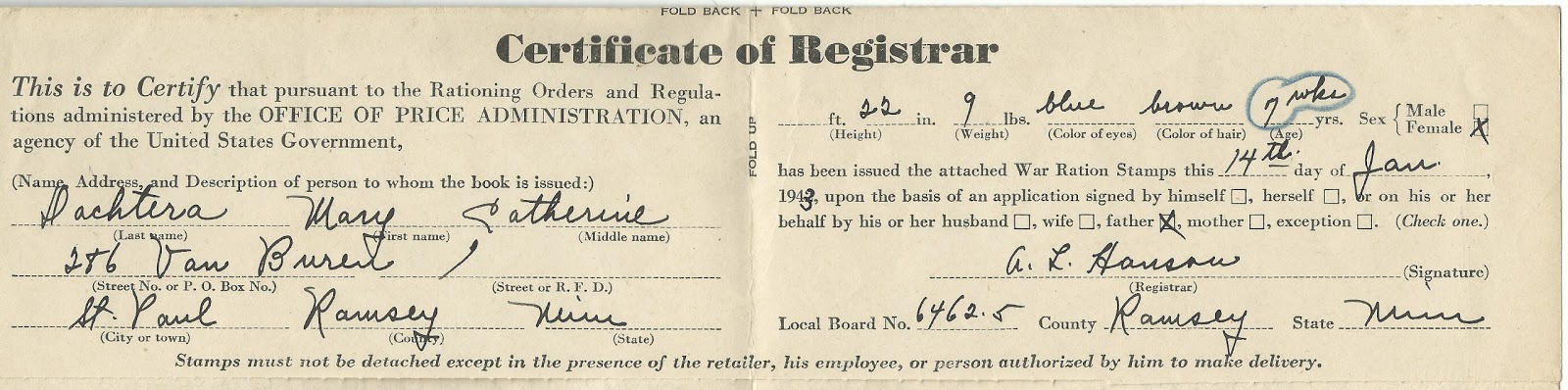
My first WWII ration book.


During Wold War II, rationing was the system put in place in the U.S. to make sure that everyone had access to the necessities of life – even if quantities were limited..  Everyone was issued ration books – I had one in my name when I was only 7 weeks old. Children were issued ration books to insure that families had access to adequate goods. When it came to rationed goods, a person was allowed to purchase only a certain amount at any given time.  The books contained stamps that were collected by retailers at the time of purchase.


In order to preclude a black market in ration stamps, retailers were prohibited from accepting stamps that had been removed from the books.  Rationed items included, rubber, leather, sugar, meat, fats and oils, and gasoline among other things. More information about rationing can be found here:   http://www.ameshistory.org/exhibits/events/rationing.htm


Sunday, September 13, 2015

Story Interrupted.


My favored family story platform, StoryPress.com seems to have gone belly-up. It was VERY user friendly and FREE. Easy to upload videos or photos and add narration. I discovered it when Thomas MacEntee announced he’d done a story about his mother.   This was shortly after I’d struggled to produce my first YouTube video.

I was amazed at the simplicity of StoryPress. It is disappointing that the site will be shut down at the end of September.  Apparently the venture was not profitable. They say they’ll review their business model to see if they can come up with revisions that will make it work for them.  I hope they are successful.

The good news is that I was able to download backup copies of my stories; and that the backup consists of separate image and audio files. I won’t have to start from scratch.

The goal is to create a history in an appealing contemporary format. What is the likelihood that my kids and grandkids would read it in a book?  Small. So multimedia is my choice.

A year ago my impatience led me to give up on Microsoft’s Movie Maker because it is not intuitive – at least to me. But I’m going to try it again after watching a couple of tutorials. (When all else fails, read the instructions.) It’s always a bit frustrating trying to learn new software but I’ll give it a go.

I’ll be redoing the stories I had on StoryPress and posting them on YouTube.  They are “War Baby” and “The Shipp Family in Prussian Poland”.  Then I’ll resume work on the next story about crossing the Atlantic as a passenger in steerage in the 1880s.

Back to the drawing board.


Wednesday, March 11, 2015

I have the data - now to add the information.


My ancestor search (for my own ancestors) is slowly coming to a halt approaching a big brick wall.  Well, actually it’s not brick but I’m not sure I have what it takes to penetrate it.

Polish Roman Catholic church records before the 18th century – and in some cases into the 18th century are paragraphs of handwritten text in Latin. Later records generally have the data entered into labeled columns in the record books like this:


Language isn’t the problem with the early records, the problem is mostly the handwriting. Add to that the fact that many of the pages are faded or damaged by time. Ancient European handwriting is my (not exactly) brick wall.  Here’s a sample of one of more legible record books.


While it would be nice to know the names of my 3rd 4th and 5th great grandparents, I’m not sure that it is worth the effort to try to decipher these earliest records.

Why not?

My goal has been to understand my family history. I believe that I now know enough about that history to be able to add context to the names and dates.  My ancestors were peasants in a part of the world where civil records were not kept until 1874. They were farmers and laborers who were pretty much invisible in their times except to one another.

I can extrapolate from the known names and dates to guess when earlier generations lived. So even if I don’t know their names, history tells me much about their circumstances.  Were their leaders tyrants or magnanimous? What wars were going on?  Were there famines or floods?  I can go far back in time even without being able to name individuals.

I won’t stop searching. Don’t get me wrong. But I’m at the point of getting diminishing returns from poring over the available records.  

New projects for my ancestors will involve trying to depict my ancestors and their lives in words and images and share those with my extended family.  That’s a daunting challenge.  Maybe it would be easier just trying to decode the ancient scribbles.


Saturday, January 10, 2015

A new site to help add context to your ancestors’ lives.


Wouldn’t it be great to have quick access to an historical timeline and a summary of the time in which your ancestor lived?  You can have both at History Lines.

History Lines is still in beta test, but you can sign up to be a beta tester. Because it’s still in beta, there are a few glitches but that’s what beta tests are for. There is a feedback button so that you can offer any suggestions you may have for improving the product.

Enter your ancestors name and birth and death dates and you get both a timeline and a short narrative account of what daily life was like and the impact of significant events.  Here’s a screenshot of one person that I entered.


The areas covered in the summary are:
•           Childbirth
•           Childhood
•           Clothing
•           Communication
•           Diet
•           Education
•           Entertainment
•           Household
•           Hygiene
•           Marriage
•           Medicine
•           Military
•           Politics
•           Religion
•           Transportation

Stories are currently available in England, Ireland, Scotland, Wales, United States, 1600 to 1950

They’re currently working on Germany and they need user input to prioritize which countries to add next. I sure hope their German information will include Prussia.

I’m excited about this site because it will help me add flesh and context to family history.  The summaries will point me to areas I want to research further.


Great start History Lines!