Translate

Thursday, April 21, 2022

Pretty Women


My first memories of my maternal aunts were as middle-aged (at least) women. Perspective: My mother was the 10th of 11 children. She was 30 when I was born, so her sisters ranged in age at that time from 34 years to 48 years old. For a small child, they seemed “old”.

I had a fresh look at these women when a cousin recently sent me a box of old photos including some of my aunts’ wedding photos. It was wonderful to see my aunts as lovely young women.

I scanned these photos and then took advantage of the colorizing service offered by MyHeritage.  You may need to be a member to take advantage of this service.

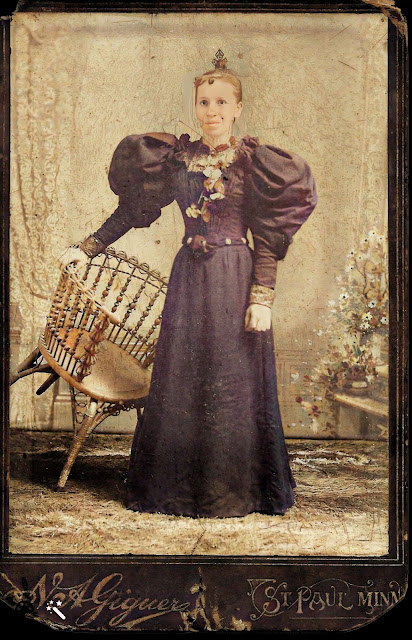
They are posted below along with a photo of my maternal grandmother that was probably from the mid 1890’s judging by her dress.


And my maternal Grandmother, Stella Schipp  

I am so glad to be reminded that they were once young, lovely and lively. It would be great to be able to go back in time and know them as they were then.


Saturday, April 2, 2022

1950 Census


I found myself on the 1950 census! Don’t know why it was so important to me, but it was.


 It was fun browsing my Enumeration District in Northlake, IL.  Brought back memories of people I hadn’t thought of in years. I’ll also look at Northlake’s other ED to find kids in my class at St. John Vianney school.

I looked for my cousins born in the ‘40’s but didn’t find them all because I don’t have their 1950 street addresses. At this date, the census has just been released and is not yet indexed, so you need to know the street address of the person you’re looking for. More info down below in this post.

Then I went browsing the EDs where my grandparents lived.

I know that in the 1940’s there were several Dachtera relatives living near my Grandmother’s house. A few of them were still there in 1950 – all in their 70’s by then.

Grandma Ganas was living alone in1950 in the same house where my mother grew up.  I found my mother’s sister Stella & family, who were living near my Grandma.

Neighborhoods have changed from when I knew them as a child. Homes where relatives lived in 1940 are occupied by strangers in 1950. I found that a bit jarring to my memories. It is hard to imagine other families in those homes that I once knew.

This census is very different from previous ones. The form is different, and the enumerators’ instructions are very different.  Until indexing is completed you must know the 1950 street address of the person you are looking for. With that info you can find the correct ED (Enumeration District). Once you have that you must browse page by page to find your person.  Or you can wait a few months for the indexing project to be completed.

It is well worth the time to view YouTube videos to learn more about it. Here’s one of many Lisa Louise Cooke 1950 Census Seminar

A Google search can also get you to the instructions you need.

Time marches on. I was 7 years old in April, 1950. 


Monday, October 18, 2021

Dachtera Immigration Story

 Finally almost finished. I don't like recording and hearing my own voice so it took a while to get around to doing the narration for my Dachtera immigration story.  It still needs some editing. If you watch it, I'd like to hear your suggestions for improvement.

Dachtera Immigration Story


Saturday, October 16, 2021

Down a Rabbit Hole


I’ve been down a rabbit hole for a couple of weeks, but finally came up for a breath of fresh air. Finding distant cousins via DNA matches led me into a maze. 


I have a match who seems to descend from my paternal Grandmother’s line. She also descends from a line that seems identical to one that married into my paternal line. Both surnames match.

Veronica Reczynska was married to Lawrence Lewandowski. My paternal grandmother was Tekla Reczynska; I can find no connection to Veronica.  John Lewandowski married my great aunt Pauline; I can find no connection to Lawrence.

I confused myself and went round and round in circles for too long before I finally decided to let it rest for a while. This could all be just coincidence. I’ll get back to it after a while.


Monday, September 20, 2021

Is It Soup Yet?


This post is inspired by Judy G. Russell’s blog post Not soup in 2021 either.

Her point is that the admixture results we get from DNA tests ARE ESTIMATES. They are educated guesses. Please note that these estimates vary from one testing service to another. They are not definitive; but some of the unexpected results may be interesting.


I claim that these estimates are soup. Soup in progress – still on the stove but not the final product. 

Soup is generally a combination of several, sometimes many, ingredients. So are we. Looking at a soup pot on the stove we can easily see the large ingredients; but what about the herbs and other small bits that give the soup its flavor?

My first views of my admixture showed a couple of surprises. I trace my Polish ancestors to the late 18th century – all in Poland. So why am I being told that I show Scandinavian or Greek heritage?

Well, history implies the Scandinavian part. In the 1650’s there was a 5 year war between Sweden and Poland. Five years!. I’d bet that some Swedish soldiers married and settled in Poland. I have no doubt that many other Swedish soldiers left their DNA scattered among Polish women.

Greek is a little more far-fetched, but my mother’s maiden name is Ganas. A search on that surname shows mostly Greeks. So maybe several hundred years ago a traveling merchant from Greece chose to stay in Poland. I’ll never know but it brings up a possibility.

I’m glad that my curiosity led me to look at these seeming anomalies. They make my heritage a bit more interesting.

I am comforted by seeing my admixture concentration where I’d expected it to be. But if, as 23andMe tells me, I carry Neanderthal genes, then I probably also carry some from Sweden and Greece.

My point is that while admixture is just an ESTIMATE, some of the outliers may be worth consideration.


Sunday, September 19, 2021

Oh, Cousin – Where Art Thou?


My current focus is on finding cousins via DNA matches. I’m still waiting for results from my Ancestry.com test, but there are lots of matches from my 23andMe and My Heritage tests.

Image lifted from Twisted Twigs on Gnarled Branches


I got all excited when I learned about DNA Painter.  I downloaded match information and painted it. It’s a very colorful DNA map. But I also created a problem for myself and now I’m having to backtrack a little.

Problem: I failed to finish the research to add some of them to my family tree. I am a “big picture” person who sometimes tends to gloss over the details. That almost always causes problems, but the details are not the fun part.

So now my task is to summon some self-discipline to bring my tree up to date. Self-discipline isn’t the fun part either


Monday, September 6, 2021

Playing Catch-up


There are so many new tools for genetic genealogy that it’s been a challenge to catch up.

DNA Painter has some great tools. Here’s a sample of my chromosome map showing that I’ve painted 43% of my map. The legend on the right shows the familial relationships. I’ve mapped matches from 23andMe, MyHeritage, and FTDNA. I don’t yet have results from my Ancestry test.

The legend also shows that I’ve imported the ethnic origins of my chromosomes as interpreted by 23andMe, but they’re not displayed in this image.


Another useful tool is Blaine Bettinger’s Shared cm Project. The Shared cM Project (ScP) is a collaborative data collection and analysis project created to understand the ranges of shared cM associated with various known relationships. Click on the link for an explanation of the project.


DNA Painter will also show your family tree based on the ancestors you have listed and showing the color of each group.


There’s a contrast between my ethnic origins as shown by 23andMe and those from FTDNA. Both of these reflect the raw data from the same test.

Here is a sample of the DNA Painter chromosome map showing ethnic origins as per 23andMe. Familial relationships not shown in this image.


And here is the chromosome map of my ethnic origins as interpreted by FTDNA. Again, the same raw data as above.


Another interesting contrast is between 2 different tests interpreted by My Heritage. My Heritage does not have a chromosome mapping tool, so here are the two maps.

23andMe DNA test raw data as interpreted by My Heritage


My Heritage DNA test raw data as interpreted by My Heritage.

Conclusion: DNA analysis is an evolving process.


Friday, August 27, 2021

Wading in Unfamiliar Waters - DNA Painter


Taking a look at a couple of new (to me) things. New tools for my toolbox. I’m just beginning to give them a try. I wonder if they’ll be useful for me. Part I discussed WikiTree. Here's DNA Painter.

DNA Painter   


It’s been just a few days since I discovered DNA Painter. I’ve only scratched the surface, but I love it. DNA Painter is free. Here’s a quote from a Google search for DNA Painter: 

“DNA Painter is an easy-to-use tool that helps genealogists make sense of DNA testing. By mapping segments of DNA to chromosomes, we can begin to see which ancestors gave us which pieces of DNA, and thus how new matches are related. ... “This is the most user friendly, easy to use mapping tool.”

Your DNA testing site will show you where your matches fit onto your chromosomes. You may upload data from any DNA site that has your data. This is how a first cousin matches me.


Bringing that data into DNA Painter will show an identical map.

Then you can bring in other DNA matches that will be added to your chromosome map. Here’s an example of a portion of my chromosome map after adding a few more matches:


The different colors indicate which ancestor (or ancestors) is the source of that DNA segment.

The very many available tools permit analysis and give an opportunity to make valid inferences about matches where you do not know the ancestral source of the DNA. Although this is free, there is a subscription option that includes more tools.

I don’t yet know enough about it to be able to explain further, but a Google search will find many sites with information and help.  Here are a few links:

DNA Painter review – Is it the best tool for DNA visualization?

 I’m Hooked on DNA Painter. You Should Be, Too.

DNA Q&A: Do I Need DNA Painter?


Tuesday, August 24, 2021

Wading in Unfamiliar Waters - WikiTree


Taking a look at a couple of new (to me) things. New tools for my toolbox. I’m just beginning to give them a try. I wonder if they’ll be useful for me.

  WikiTree


Community family trees have always been off-putting for me.  While I love Family Search, my tree there is just a stub because I don’t like the idea of others being able to make changes without my approval. WikiTree, however presents itself as a collaborative world tree. My present understanding is that I “manage” the people I put there and others cannot make changes at will.

It is labor intensive because each person must be added individually – a pain if you’re doing manual entry, but it is also time consuming if you upload a large GEDcom file.

That’s what I did. Uploaded a GEDcom with more than 2,000 people. WikiTree then scans its database to find who in your file matches someone they already have. So I ended up with a HUGE table of names from my tree that did not have a match. 

The good news is that you can add people from your file, and all of the information from your GEDcom is added to WikiTree.  At first glance, I could not figure out how the entries in the table were sorted. It seemed to be alphabetical, but there were areas that seemed out of place. I did a lot of scrolling up and down the pages of the table.

In the end, I added my tree up to and including my great grandparents. My patience had evaporated by that time.  I do intend to go back and add my great aunts and uncles

Friday, August 20, 2021

Ancestry DNA Test – finally


Finally doing an Ancestry.com DNA test. I’ve resisted doing a DNA test from Ancestry.com because I didn’t think that it would give me any better information that I have from the 23andme and My Heritage tests. I’ll be surprised if it does.

I did 23andme when I was diagnosed with Triple Negative Breast Cancer. I wanted some idea of my daughter’s vulnerability.

A few years later I did the MyHeritage test because the protocol was newer and I’m hoping to find cousins in Poland. MyHeritage has a huge presence in Europe.

I am not now actively pursuing my Polish heritage. I think that I’ve traced my ancestors as far back as is practical for Polish peasants – the late 18th century. So I’ve moved into a different phase – finding more cousins and learning about them.

That brings me to the Ancestry DNA test. There seem to be many trees that list my known relatives but are posted by people I don’t know. My hope is to find dozens of matches that will introduce me to more distant cousins.


Tuesday, August 17, 2021

Ancestry’s newest revenue stream: Your photos and documents.


This is old news by now. Ancestry.com claims ownership of every image on your family tree. This includes photos of people or images of documents that you’ve uploaded, such as letters or personal documents. They reserve the right to use our images for whatever purpose they choose.  


·       Advertising

·       Promotion

·       Educational videos

·       Anything else they want to do with our images.

While I doubt that any of my photos would ever have any commercial value, I resent that they would be appropriated by an organization that has no connection or interest in them other than producing revenue.

I have deleted all photos of people in my tree on Ancestry.

But here’s the thing: If others have added your photos to their trees, those images are still available to Ancestry unless they’ve also been deleted from those other trees.

Several blogger have written about this, but I  think that the best is from Dear Myrtle "

The Sky is Falling, Or Is It? #Ancestry TOS Challenges

Just plain greed.


Saturday, July 31, 2021

Making Progress on the Dachtera Immigration Story


I've plunged ahead with the immigration story of my paternal Great Grandparents, Joseph and Magdalena Dachtera. The first draft of the narration is 99% complete. Still thinking about how to end the story. It’s been “resting” for a couple of days so that I’ll start editing with a fresh eye.

Spent a couple of days researching and finding images to flesh out what began as a GoogleEarth tour. Went back to the BaSIA  database to try to clarify and add information.

There are two wonderful Wielpolski databases – both built by volunteers.

The Poznan Project http://poznan-project.psnc.pl/ works to transcribe all 19th century marriages in the province. Information given includes film numbers for the appropriate microfilms at Family Search.

BaSIA http://www.basia.famula.pl/en/ is a much broader project to transcribe all vital records from the province. Images from records may be from church or synagogue records or from civil records. Available records may be from the 13th century to the 19th century.

For now, it’s time to get started with the editing.

In addition, I’ve also spent some time looking at DNA info, making sure that I’m up to date on matches from various sites. It’s time to get up to speed on the tools at GEDMatch


Thursday, July 22, 2021

A Fork in the Road – What to do Next


Well, I accomplished one task I mentioned in my last post – I found the connections between my Minnesota Ganas clan and the ones that settled in Milwaukee and Buffalo. We are all descended from Johann Ganas, b 1779, d 1830

Martin Ganas came to the US in1890 and settled in Buffalo.

Johann arrived in 1891 and settled in Milwaukee

Ignatius (My Grandfather) immigrated in 1892.

Makes me wonder whether these semi-distant cousins were in communication about their emigration plans while still in Poland.

All records are from the town of Czerlejno which you can find with Google earth; and even do a Street View tour along the two main crossroads.

I am truly grateful for the work of the volunteers who transcribe  these ancient records for databases that allow us to find our ancestors.


What’s next?

Finishing the Google earth trip/tour of my paternal immigrants seemed like a good idea for the next project until I found that Tour Builder is no longer supported. So that project turns into a YouTube project. This will take a while. Storyboard and finding the right images. I also need to improve my narration voice.  I’ve done a few other family stories on YouTube. See them here: Family Stories

And also -

I’ll continue to look for resources for my kids’ Bohemian heritage.

I’ll continue to check for new DNA matches.

Time to start working on a storyboard.


Sunday, July 18, 2021

Resuming My Quest


I quit doing genealogy research a couple of years ago because I was just plain burned out.  I simply stopped. Left projects half-done or barely started.  Since then, I’ve dabbled a bit.

Recently I’ve tried looking at my children’s paternal line but have gotten nowhere because I cannot find where they lived in Bohemia in the 19th century. It’s been an exercise in frustration.

Now my cousin, Jeanne, is resuming her research; and that has inspired me to get back to mine.

But how do I begin to pick up the pieces? There are so many of them. Which pieces to pick up first? Can I find where I left off?  Going back to my Bullet Journal should help.

I’d started:

·       A Google earth trip showing my paternal ancestors path from their home in Poland to their new home in St. Paul, MN.

·       A search for possible Polish relatives who settled in Milwaukee and in Buffalo.

·       A story about the times my parents grew up in.

And there are other loose threads, too.

Hints on Ancestry.com have shown diminishing results over time.

I think I’ll take a closer look at Smart Matches on My Heritage.

Here goes.

Saturday, March 30, 2019

On a Long, Long Break


I did not realize that my last post was more than a year ago. 

Fact is that I just burned out. For years my enthusiasm had me treating my research like a full-time job but I'm too old to have a full-time job. On top of that I spent 3 years in a fairly demanding position in my local genealogy society (I should have quit after 2 years). Then add the kinds of things that tend to lead researchers into a slump.

It was as though someone had pushed my “off” button.

I was in the middle of creating Google earth family history tours of my immigrant ancestors from their arrival in the US to the cities where they eventually settled. With photos along the way. I stopped dead. Now my interest is beginning to reawaken after ignoring genealogy for many months. I’ll probably get back to it before long.

In the meantime, I’ve begun a new hobby that is engaging and stimulating – amateur microscopy. It is a huge learning experience and fun. I even started a blog mostly as a summary of my progress Microscopy:Confessions of a Newbie  I’m hoping that this will provide a distraction that will keep me from obsessing on genealogy while still making progress.

I’ll be back.

Sunday, February 18, 2018

I Now Have a Research Disciplinarian


No whips. No threats of harm to me or my family.  It’s software that forces me (sort of) to do step-by-step research planning and gives me a place to put research notes. This is necessary because I have no self-discipline.

I mentioned Research Ties in my 4 Feb 2018 post Getting my Act Together…
I learned about it in Researcher’s Guide to American Genealogy  4th Edition by Val D. Greenwood. He implies that he uses it. It is a cloud based program specifically designed for family history.  I signed up for a 2-week trial.

It was a rocky start in spite of having a Beginner’s Guide and a series of tutorials. Even with that help, it was non-intuitive to me. Could have been crystal clear to other folks, but not to me. I stuck it out and now think I’ve mostly got the hang of it. Mostly.

Research Ties leads you through your research step-by-step.  You can upload a Gedcom file or enter individual names manually.

You first state an objective.
Then one or more searches to accomplish that objectives.
Then the results of each search.

The discipline comes in defining each step and then carrying it out. The sequence is very logical. Left to my own devices, I tend to jump all over the place and have vague plans, if any. I go down rabbit holes and lose track of what I was looking for. I write (often abbreviated) results in a notebook - some of the times.  I am poor at citations. When I go back later, I can barely read my own handwriting let alone figure out my abbreviations.

There are two great benefits: a) because it’s in the cloud, I can use it with my tablet when away from home; b) it has excellent report capability.  Reports can be downloaded in either MS Excel or PDF format.

I have now signed up for a $30 annual subscription.

DISCLAIMER: This works for me mostly because I use 2 displays. When doing online research, I have Research Ties on one screen and do my searches on the other.  I am not certain this I would be so enthusiastic using only one screen and having to switch back and forth between applications
.

Sunday, February 11, 2018

Aunt Martha - a Role Model


 Aunt Martha was unique in my family. As a child, I didn’t understand what a role model she was. Martha was born in St Paul Minnesota in1907; the 7th child of my maternal grandparents Ignatz and Stella Ganas. 

She was the only one of my mother’s 10 siblings who moved away from St. Paul as a single person. I’ll never know why she left, but the most common of the family lore says that she fell in love with a Jewish man. Religious conversion was not in the cards for either of them. So, she got on a train with a couple of friends and headed west sometime in the 1930’s.

After visiting towns in North Dakota and Montana she spent a season working in. Yellowstone National Park. She took a lot of photos, but not one has a date on it.  By 1938 she was in Pasadena, California taking snapshots of the Rose Parade. She finally settled in Oakland, California. She travelled the west coast and made regular trips back to St. Paul.

My first real memories of Aunt Martha were her visits to us in Chicago.  She was a superstar to me because of her travels but mostly because she traveled by air. What luxury that seemed to me! We’d go to Chicago’s Midway airport (this was way before O’Hare), go out on the observation deck and watch the planes arrive and depart.

Martha would arrive on a TWA Constellation.  (Here's another article.)  What a beautiful plane! I fell in love with it and still love it to this day. The sleek and graceful curves truly set her apart from other planes of the time.


I loved Aunt Martha because she was a loving, kind, gentle woman, and also because she was never condescending to a little kid like me.

I grew up in a time when girls were still expcted to grow up, become secretaries, get married and have babies. I grew up appreciating Martha her for her spirit, her poise, her wanderlust and her independence. All were an inspiration to a young girl. Thank you Aunt Martha.


Sunday, February 4, 2018

Getting My Act Together Version (too many to count)


I’m pretty much a “big picture” person, preferring to look at the larger scope of things. That means that many of my i’s are left undotted and not all of my t’s are crossed.  Over the years, I’ve made several attempts at keeping a research log. Some lasted longer than others. I get distracted and then cannot remember exactly what I did about whom. Well, here I go again.

 Inspired by Val D. Greenwood’s 4th edition of The Researcher’s Guide to American Genealogy I will again try to keep (get) things organized. In chapter 7: Organizing and Evaluating Your Research Findings,  p.143.   He makes very specific recommendations for paper based forms and methods using a Research Log in conjunction with Research Notes, and how to synchronize them.

But what got my attention was his discussion of a software program called Research Ties. Apparently, Mr. Greenwood uses it.  It was developed by Jill Crandall specifically for genealogy research.  There’s no need to download anything, it is all in the cloud.  I’ve signed up for a free two-week trial.

On the first pass, it doesn’t seem very intuitive to me even though I’ve printed the Beginner’s Guide, so I guess I’ll actually watch the tutorials.


Sunday, January 28, 2018

It Is More Than Recording Names and Dates


What do you know about your ancestors? You may have documented births, marriages and deaths, but do you know who they were? Where they lived? Where they came from? What were the economics and demographics of their time and place?

These are questions that often could not be easily answered in years gone by. Today’s technology helps us find those answers.

In James Tanner’s recent blog post Where is Genealogy Technologically-wise?, he begins by discussing the history of genealogy and the limitations imposed by the technology of the times. Early researchers often were lucky if they could find names and dates. But the evolution of technology is giving us access to unprecedented amounts of information.


What excites me and inspired this post was having such a revered genealogist remind us all that our ancestors were real people about whom we can learn more than just names and dates. He encourages us to take full advantage of technology. With his permission, I present the second part of that post. (See the link above to read the entire post.)


Genealogy involves several skills that draw on several areas of academic expertise. If you look at the common divisions of academia as reflected in university catalogs, you would see that genealogy involves many different areas. These include some of the following disciplines:


·                     History
·                     Languages
·                     Library Science
·                     Geography
·                     Economics

If we break away from thinking of genealogy as a trivial hobby of filling out forms, we begin to see the limitations of constraining our records to electronic representations of paper forms. Rather than "attaching a source or memory" about a person, what if we begin with a narrative? Rather than being presented by a program with a series of blank fields, what if we were guided by a series of questions about the person's life? Let's suppose the computer program started out like this:

What do you know about your father (mother, aunt, uncle, etc.)? Where was your (relative) born? Who were the members of his or her family? Do you have any photos or stories you can remember about this relative? We have found a U.S. Census record that seems to have information about your (ancestor). What do you see in this record that might help add information about this person or family? Here is a timeline of the time when your ancestor lived? Do you know where the ancestor lived?

In other words, we break out of the shackles of the paper-based view of genealogy and start putting the information into a historical context and do this by begging (sic) a narrative. What do we end up with? Essentially a website dedicated to a family with links and photos and stories.

At the same time, we could add in some artificial intelligence that could begin to correct the information entered. For example, an extensive expansion of the error messages now generated by some programs.

The interesting thing is that all this is now available. Rather than providing a confusing pile of information, how about using the computers to organize, help evaluate and record the information in a way that leads us through the process rather than requiring years of experience to get
started?

Thank you, James for encouraging us to expand our scope.


Saturday, January 20, 2018

Genealogy as a Political Tool


Let me state from the beginning that I will not express an opinion on this topic.  I do find it interesting that Jennifer Mendelsohn has combined two of her passions; one fueling the other.